Draft — pending fishing-accuracy review. Not listed on the site and not indexed by search engines.
Techniques
Rigging a Surfcasting Setup, Step by Step
Fishing.com.cy Editorial · 5 min read · Published · Updated
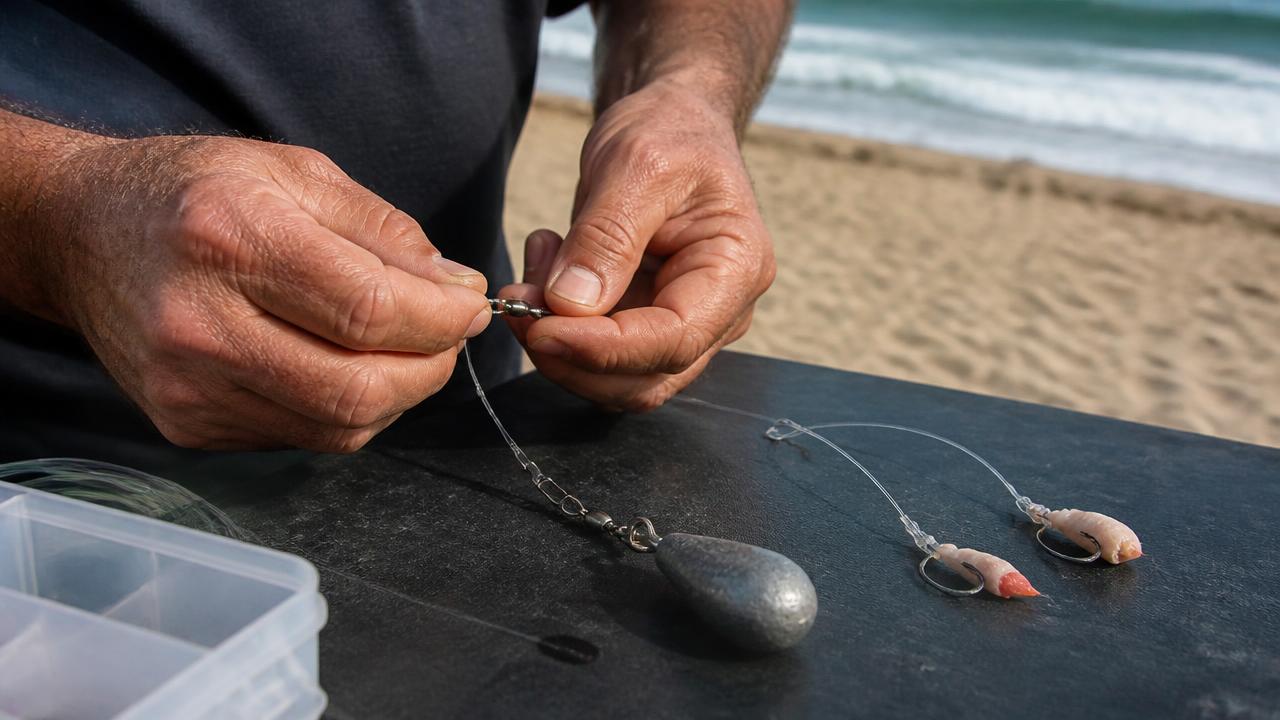
Getting the rig right is often what separates a frustrating surfcasting session from a productive one. This guide walks through building a surfcasting setup from the mainline outward: the shock leader knot, the two most common rig styles for Cyprus beaches, how clipped-down rigs work for long casting, and how to choose hook sizes and sinker types for the ground you are fishing. It complements our guide to rods and reels and our complete surfcasting guide, both linked below.
Step 1: Mainline and shock leader knot
Start with your mainline, whether mono or braid, and attach a shock leader sized using the rule of thumb of roughly 10 lb leader strength per ounce of lead you intend to cast. The leader should be long enough to have several turns on the spool before the cast, generally around one and a half times the rod length.
A leader knot needs to be strong, reasonably compact and able to pass smoothly through the rod rings during the cast. A reliable option most surfcasters use is a form of Bimini twist or a mahin/leader knot that creates a smooth, tapered transition between the two line diameters — thick, lumpy knots catch in the rings and cost distance, or worse, fail under the shock load of a hard cast.
Step 2: Running ledger rig
The running ledger is one of the simplest and most versatile surfcasting rigs. A weight runs freely on the mainline (via a bead and swivel arrangement, or a sliding boom) above a length of hook trace tied to a swivel, ending in a single hook. Because the sinker can slide, a taking fish feels little resistance when it first picks up the bait, which can improve hook-up rates with more cautious feeders.
This rig is a good choice when fish are feeding delicately or when you are specifically targeting species known to be finicky, such as mullet or larger bream, and it is simple enough to tie confidently in the dark.
Step 3: Paternoster rig
The paternoster rig holds the sinker at the terminal end of the rig with one or two hook snoods branching off above it on short traces, holding baits up off the seabed. This is the standard multi-hook rig for general Cyprus beach fishing, since it lets you present two different baits at different heights simultaneously and generally casts a little more predictably than a running ledger because everything is tied in a fixed formation.
Keep snoods relatively short (typically 15–30 cm) to reduce tangling during the cast, and stagger the two snoods along the rig body rather than clustering them close together.
Step 4: Clipped-down rigs for long casting
For maximum distance, most Cyprus surfcasters use a clipped-down version of the paternoster, where the hooks and baits clip up against a rig body or the leader itself using small plastic bait clips. This streamlines the whole rig into a single, low-resistance shape during flight, dramatically reducing air resistance compared with hooks and snoods flapping loose.
The baits release from the clips automatically as the rig lands and the leader tension is released, letting the hook snoods swing free and present naturally on the seabed. Clipped rigs take a little more care to tie correctly — the clip needs to release cleanly under casting tension but not so easily that it releases mid-flight — but the distance gain over an unclipped rig is usually worth the extra care.
- Clips reduce air resistance and add meaningful casting distance
- Snoods should release cleanly on landing, not during the cast
- Best suited to open beaches with room for a full-power cast
- Slightly fiddlier to rig in low light — practise at home first
Step 5: Choosing hook sizes
Hook size should match both the bait and the target species rather than being fixed for every session. For general bream, small bass and mixed species work off Cyprus beaches, hooks in roughly a size 2 to 1/0 range cover most bait presentations, with smaller sizes suiting smaller worm or strip baits and larger sizes suiting bigger fillet baits or when targeting larger fish.
A long-shank hook makes unhooking easier and is a sensible choice for worm baits, while a shorter-shank, wider-gape hook often suits fillet or strip baits better and improves hook-up rates on the take.
Step 6: Sinker types for sand vs mixed ground
On clean, open sand such as much of Lady’s Mile, a plain bomb or torpedo-shaped sinker is usually all that is needed, since there is little current to hold against and no need for extra grip. These sinkers also cast cleanly and consistently, which matters when distance is the priority.
Where there is more current, wave action, or you are fishing slightly mixed ground with some weed or broken bottom, a grip or breakaway-style sinker with wires that dig in on landing holds position far better, preventing the rig from being dragged back up the beach by the surf. The trade-off is a slightly less aerodynamic shape and marginally reduced casting distance, which is a fair exchange for staying put in a hooked-fish scenario in rough water.
Frequently asked questions
- What is the difference between a running ledger and a paternoster rig?
- A running ledger lets the sinker slide freely on the mainline above a single hook trace, giving little resistance to a taking fish. A paternoster fixes the sinker at the end with one or two hook snoods held up above it, allowing two baits to be fished at different heights at once.
- Why use a clipped-down rig for surfcasting?
- Clipping the hooks and baits up against the rig body during the cast reduces air resistance significantly, which usually adds meaningful extra casting distance compared with an unclipped rig with hooks flapping loose in flight.
- What sinker should I use on sandy Cyprus beaches?
- A plain bomb or torpedo-shaped sinker suits clean, open sand with little current. Where there is stronger current, surf or mixed broken ground, a grip or breakaway sinker holds position far more reliably.
- What hook size is best for surfcasting in Cyprus?
- Roughly a size 2 to 1/0 covers most general bait fishing for bream, bass and mixed species, with the exact size chosen to suit the bait being used and the size of fish you expect to encounter.
- How do I tie a shock leader to my mainline?
- Use a smooth, tapered leader knot such as a Bimini twist based connection that passes cleanly through the rod rings without catching, and make sure several turns of leader sit on the spool before you cast to protect the mainline from the shock of the cast.
Recommended gear for this guide
Live picks from the Hobby Mania Cyprus catalogue that suit the setups described above.
Share this guide