Draft — pending fishing-accuracy review. Not listed on the site and not indexed by search engines.
Gear & Tackle
Choosing a Surfcasting Rod and Reel for Cyprus
Fishing.com.cy Editorial · 5 min read · Published · Updated
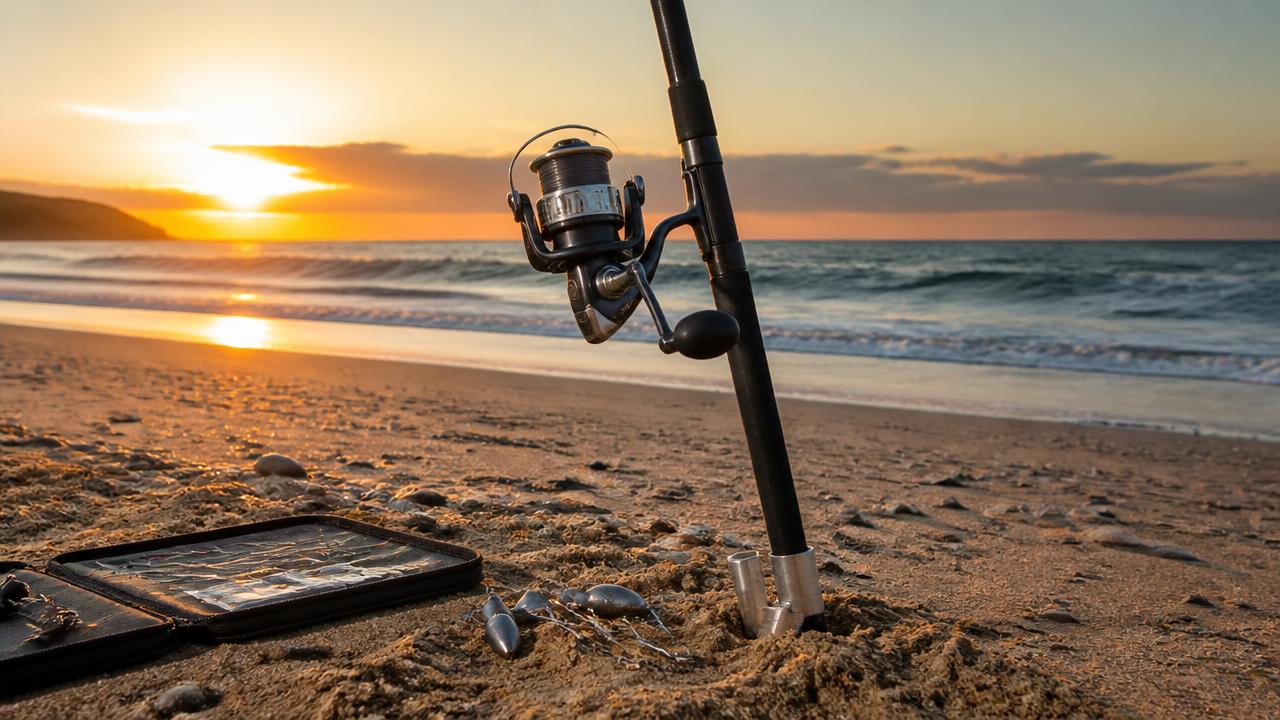
Choosing a surfcasting rod and reel is largely a question of matching the tackle to the casting weights and distances you actually need on Cyprus beaches, rather than chasing the longest or most powerful setup available. This guide walks through rod length, casting weight and action, reel size and line lay, and the mainline and shock leader choices that tie the whole system together. It sits within our surfcasting cluster — for the full picture on technique and location, see the complete guide linked at the end.
Rod length: 3.9 to 4.5 metres
Most surfcasting rods suited to Cyprus beach and mixed-ground work fall between 3.9 m and 4.5 m. Shorter rods in this range (around 3.9–4.2 m) are easier to handle in a confined casting space, lighter to carry on a long walk, and still capable of respectable distance for most beach situations. Longer rods (4.2–4.5 m) give a longer casting stroke and generally more distance, plus a little extra clearance for lifting line over waves or obstructions on the retrieve.
There is no single correct length. A shorter rod suits anglers who value manoeuvrability, fish in tighter spots, or simply find a long rod tiring over a full session. A longer rod suits open beaches like Lady’s Mile where maximum distance is genuinely useful and there is plenty of room either side to cast freely.
Casting weight and action
Casting weight ratings are usually given as a range, for example 100–200 g. Choose a rod rated for the sinker weights you will actually use — a 4–6 oz lead is typical for Cyprus surf conditions, heavier in strong wind or current, lighter on calm days. Overloading a rod beyond its rated range risks damage; underloading it makes it difficult to load the blank properly and load-cast with any distance.
Action refers to how the rod bends. A fast or tip-actioned rod loads mainly in the top section, which suits anglers using a pendulum or overhead thump-style cast and gives sharp bite indication. A more progressive, through-action rod bends further down the blank, is more forgiving of casting technique, and tends to cushion sudden lunges from fish better — a reasonable choice for anglers still building casting technique.
Reel size and spool capacity
Surfcasting reels are typically large fixed-spool reels in the 6000–10000+ size range (exact numbering varies by manufacturer), chosen to hold enough line for long casts and to provide a spool geometry suited to distance casting rather than fine lure presentation. A deep, long-stroke spool throws line more freely during a cast than a shallow spool designed for finesse work.
Spool capacity needs to comfortably cover your chosen mainline diameter at the distances you intend to fish, with room to spare — running a spool near-empty after a season of casting costs you both distance and stability under load. As a rough guide, look for reels that state clear line capacity figures for your intended mono or braid diameter and choose one with visible headroom rather than the bare minimum.
Line lay and retrieve
Line lay — how evenly and tightly the line winds onto the spool — matters more for surfcasting than for most other styles, because uneven lay directly costs casting distance and can cause tangles under the sudden load of a long cast. Reels marketed specifically for surfcasting or long-distance casting are worth the extra cost over generic spinning reels for this reason alone.
A reasonably high retrieve rate helps take up slack quickly after a long cast, particularly useful when a fish is running towards the beach, but raw speed matters less here than in lure fishing — steady, reliable cranking power under load is more important.
Mono vs braid mainline
Monofilament remains the traditional and still very sound choice for surfcasting mainline. It has some stretch, which absorbs the shock of a hard cast and a lunging fish, is abrasion resistant against sand and rock, and is forgiving of wind knots. Its main drawback is thicker diameter for a given breaking strain, which slightly reduces distance and increases the effect of current drag on the line.
Braid casts further for a given breaking strain because of its thinner diameter, and gives more direct bite detection with no stretch. The trade-offs are less forgiving handling of sudden shock loads (a shock leader becomes essential, not optional), lower abrasion resistance against rock and shell, and a steeper cost. Many Cyprus surfcasters run mono as a simple, reliable default and reserve braid for calm-water sessions where maximum distance is the priority.
Shock leader rules of thumb
A shock leader is a short length of heavier line tied between the mainline and the rig, and its job is to absorb the sudden shock of the cast itself so the lighter mainline does not snap on the forward stroke. The standard rule of thumb is roughly 10 lb of leader breaking strain for every ounce of lead being cast — so a 4 oz lead calls for around 40 lb leader, a 6 oz lead around 60 lb.
The leader needs to be long enough that several turns sit on the spool before the cast, typically around one and a half times the rod length, so the knot joining leader to mainline is on the spool (not passing through the rod rings) at the moment of maximum load during the cast. Getting this wrong is one of the most common causes of surfcasting rigs cracking off mid-cast.
- Roughly 10 lb leader strength per ounce of lead cast
- Leader length approximately 1.5x rod length
- Knot joining leader to mainline should sit on the spool at full load, not in the rod rings
- Check leader for nicks and abrasion after fishing over rock or shell ground
Frequently asked questions
- What length surfcasting rod is best for Cyprus?
- Something in the 3.9–4.5 m range covers most Cyprus beach and mixed-ground situations. Choose shorter for manoeuvrability and comfort, longer for maximum distance on open beaches such as Lady’s Mile.
- Should I use mono or braid for surfcasting mainline?
- Mono is a forgiving, abrasion-resistant default that suits most anglers. Braid can add casting distance in calm conditions but requires a properly matched shock leader and is less forgiving over rocky or shell ground.
- How do I work out the right shock leader strength?
- A common rule of thumb is around 10 lb of leader breaking strain per ounce of lead weight being cast, with the leader long enough to have several turns on the spool before you cast.
- What reel size do I need for surfcasting in Cyprus?
- Most anglers use large fixed-spool reels in the 6000–10000+ size range with a long-stroke spool designed for distance casting and enough line capacity to hold your chosen mainline with room to spare.
Recommended gear for this guide
Live picks from the Hobby Mania Cyprus catalogue that suit the setups described above.
Share this guide