Draft — pending fishing-accuracy review. Not listed on the site and not indexed by search engines.
Techniques
Surfcasting in Cyprus: a complete guide to beach and bait fishing
Fishing.com.cy Editorial · 7 min read · Published · Updated
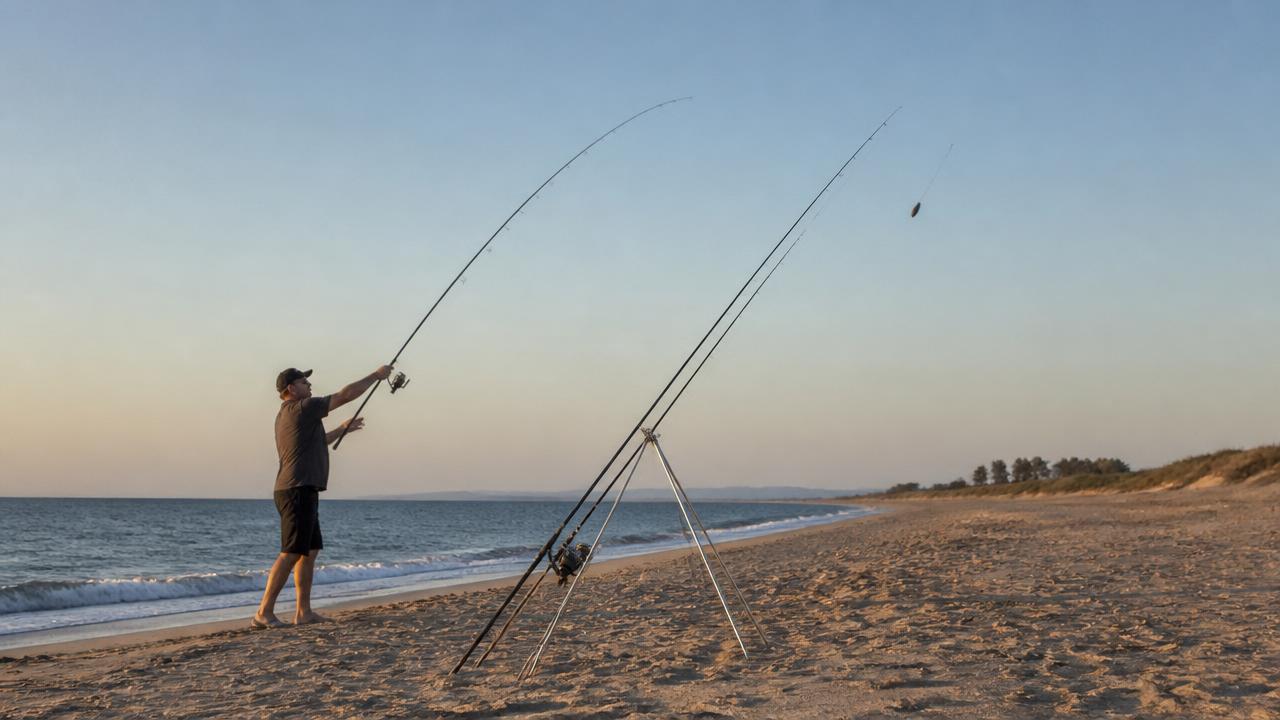
Surfcasting is the most patient and, in many ways, the most reliable way to fish the Cyprus coast. Instead of chasing marks with a lure rod, you put bait where fish already feed — sandy gullies, gutters between sandbars, the edges of weed and mixed ground — and let the sea do the rest. This guide covers the whole picture: the tackle that suits Cyprus beaches, the rigs that actually work here, how to cast further and more accurately, how to read a beach you've never fished before, and what to expect through the seasons.
Why surfcasting suits Cyprus beaches
Cyprus has long, clean sand beaches along the south and east coasts, plus mixed sand-and-rock ground that offers exactly the kind of variety surfcasting rewards. Because a bait sits still and gives off scent, it draws in fish that would ignore a moving lure, including species that spend most of their time close to the bottom.
The other advantage is accessibility. You don't need a boat, a rock mark with deep water close in, or the fitness to cover ground. A stretch of open beach, a couple of rods and a bag of rigs is enough to start, and many of the best beaches are a short drive from Limassol, Larnaca, Paphos or Famagusta.
Rods for Cyprus surfcasting
Length and casting weight matter more than brand. A longer rod gives you more leverage on the cast and keeps line higher off the water once it lands, which helps in wind and current. Most Cyprus surfcasting is done on rods between 3.9 m and 4.5 m, rated to cast somewhere between 100 g and 200 g depending on the sinker weights you expect to use.
Two-piece and three-piece travel rods are common because they're easier to transport and store, and the joins on a decent blank make no practical difference to casting distance or feel.
- Light beach work (small sinkers, calmer conditions): 3.9–4.2 m, 100–150 g casting weight
- General-purpose Cyprus beach rod: 4.2 m, 125–170 g
- Distance casting into wind or current: 4.2–4.5 m, 150–200 g
Reels, mainline and shock leader
A fixed-spool reel in the 6000–8000 size range, loaded with a long-cast spool, is the standard choice. Multiplier reels are used by some experienced casters for extra distance, but they take practice to control and aren't necessary to catch fish.
Mainline is usually monofilament in the 0.28–0.35 mm range, chosen for its stretch, which absorbs the shock of a hard cast and cushions a fighting fish on light hook links. Braid is sometimes used for extra distance and bite sensitivity, but it has no stretch, so a shock leader becomes even more important if you use it.
The shock leader is not optional. Its job is to absorb the force of the cast so the mainline doesn't part under load — a real safety issue, since a lead flying off a snapped line travels a long way. As a rule of thumb, leader breaking strain should be roughly 10 lb for every 30 g of lead being cast, tied to the mainline with a leader knot that sits neatly through the rod rings, and long enough that several turns are on the reel spool before the cast.
- Reel: 6000–8000 size fixed-spool, long-cast spool preferred
- Mainline: 0.28–0.35 mm monofilament, or braid with a longer shock leader
- Shock leader: roughly 10 lb per 30 g of lead, several turns on the spool before casting
Rigs for Cyprus ground
Rigs don't need to be complicated. Most Cyprus surfcasting is done on one of three basic patterns, and the choice depends on ground and target species more than personal preference.
Two-hook paternoster
The workhorse rig for sand and mixed ground. Two short hook snoods come off the mainline above a fixed or running lead, keeping baits up off the bottom and away from crabs. It's easy to tie, casts cleanly, and works for bream, sea bream, small sea bass and mixed bag fishing.
Running leger
A single hook trace with the lead free to run on the mainline before a bead and swivel. Because a fish can pick up the bait and move without immediately feeling the weight, this is a good choice for more cautious feeders and for larger single baits such as a whole squid strip or a big worm bait.
Clipped-down rig for distance
Hook snoods are clipped up against the rig body during the cast, reducing wind resistance and tangling, then release on the drop or the first turn of the reel. This is the rig to use when you genuinely need extra distance to reach a gulley or drop-off beyond casting range with an open rig.
Sinkers and hooks
Sinker shape should match conditions. Plain bomb or torpedo leads cast furthest and suit calm water. Grip leads with wires that dig into the sand hold bottom in current or side-on wind, which matters on more exposed beaches or when a current is running along the shore.
Hook choice depends on bait and species. Long-shank hooks in sizes 2 to 1/0 suit worm baits and smaller mouths such as bream. Wide-gape hooks in sizes 1/0 to 4/0 suit fish baits, squid strip and larger species such as sea bass. Whatever the pattern, sharpen or replace hooks regularly — sand blunts points faster than most anglers expect.
- Plain leads: calm water, maximum distance
- Grip/breakaway leads: current, wind, or holding bottom on a slope
- Long-shank hooks size 2–1/0: worm baits, bream-type species
- Wide-gape hooks 1/0–4/0: fish and squid baits, sea bass and larger species
Casting technique
Distance is useful but accuracy and consistency matter more on most Cyprus beaches, where the productive water is often a defined gulley or the edge of a sandbar rather than the furthest point you can reach. A smooth, progressive overhead cast — building speed through the stroke rather than snatching at the top — puts less strain on tackle and casts further than a rushed one.
Check your surroundings before every cast: people, dogs, other anglers' lines and low branches behind you are the real hazards, far more often than the cast itself going wrong.
Reading a beach you've never fished
A flat, featureless-looking beach almost always has structure once you look properly, and that structure is where fish hold.
- Gullies and troughs: darker channels running parallel or at an angle to the shore, often visible at low light or from slightly raised ground
- Sandbars: paler, shallower humps with deeper water either side — the drop-offs either side are prime casting targets
- Points and headland edges: where sand meets rock, current concentrates food and fish patrol the margin
- Discoloured or foamy water after wind: often marks a deeper hole or an area stirred up with food
- River mouths and drainage outlets: worth a look after rain, when they carry food out onto the beach
Fishing at night
Many Cyprus beach species feed more confidently after dark, when they move closer to the shore in the cooler, quieter water. Night sessions are a genuine step up in results for sea bass and larger bream especially through the warmer months.
Basic night-fishing discipline keeps things safe and enjoyable: set up while there's still light, use a head torch with a red-light option to protect your night vision, keep a torch handy for playing and unhooking fish, tell someone where you're fishing, and be extra cautious with tide and swell information you can't easily see in the dark.
Species and seasons
Surfcasting on Cyprus beaches produces a genuinely varied bag across the year rather than one headline species.
- Spring and early summer: sea bream, small sea bass, the odd flatfish on sandy ground
- Summer: bream species, occasional garfish and small predators after dark
- Autumn: often the best all-round period — bream, sea bass and mixed species as water temperatures ease
- Winter: sea bass fishing improves noticeably, along with steady bream fishing on calmer days
Rules, access and leaving no trace
Recreational sea fishing rules, minimum landing sizes and any protected species are set by the Department of Fisheries and Marine Research (DFMR) and do change from time to time, so check the current position before you fish rather than assuming. Some beaches have seasonal restrictions related to protected species nesting, so be aware of signage and respect any closures.
Pack out everything you bring, including old line, bait bags and rig packaging — discarded braid and hooks are a real hazard to birds and other beach users.
Frequently asked questions
- What is the best all-round surfcasting rod for Cyprus?
- A 4.2 m rod rated around 125–170 g covers most Cyprus beach fishing, handling typical sinker weights in wind and calm alike. Go longer and heavier only if you regularly need extra distance into wind or strong current.
- Do I need braid or is monofilament enough for surfcasting?
- Monofilament is the standard choice and works well for the large majority of Cyprus beach fishing thanks to its shock-absorbing stretch. Braid can add distance and bite sensitivity but needs a longer, well-matched shock leader.
- Is night surfcasting worth it in Cyprus?
- Yes — sea bass and larger bream often feed more confidently close to shore after dark, especially in warmer months. Fish it safely: set up in daylight, use a head torch, and tell someone your plans.
- What is a shock leader and do I really need one?
- A shock leader is a length of heavier line between the mainline and the rig that absorbs the force of casting a weighted lead. It is a genuine safety item, not an optional extra, since a lead flying off a snapped line is dangerous.
- What is the best bait for Cyprus surfcasting?
- There is no single best bait — worms, fish strip and squid all have their place depending on species and ground. See our dedicated guides to worm baits and to matching bait to species and ground for detail.
Recommended gear for this guide
Live picks from the Hobby Mania Cyprus catalogue that suit the setups described above.
Share this guide