Draft — pending fishing-accuracy review. Not listed on the site and not indexed by search engines.
Fishing Spots
Best HRF fishing spots in Cyprus
Fishing.com.cy Editorial · 4 min read · Published · Updated
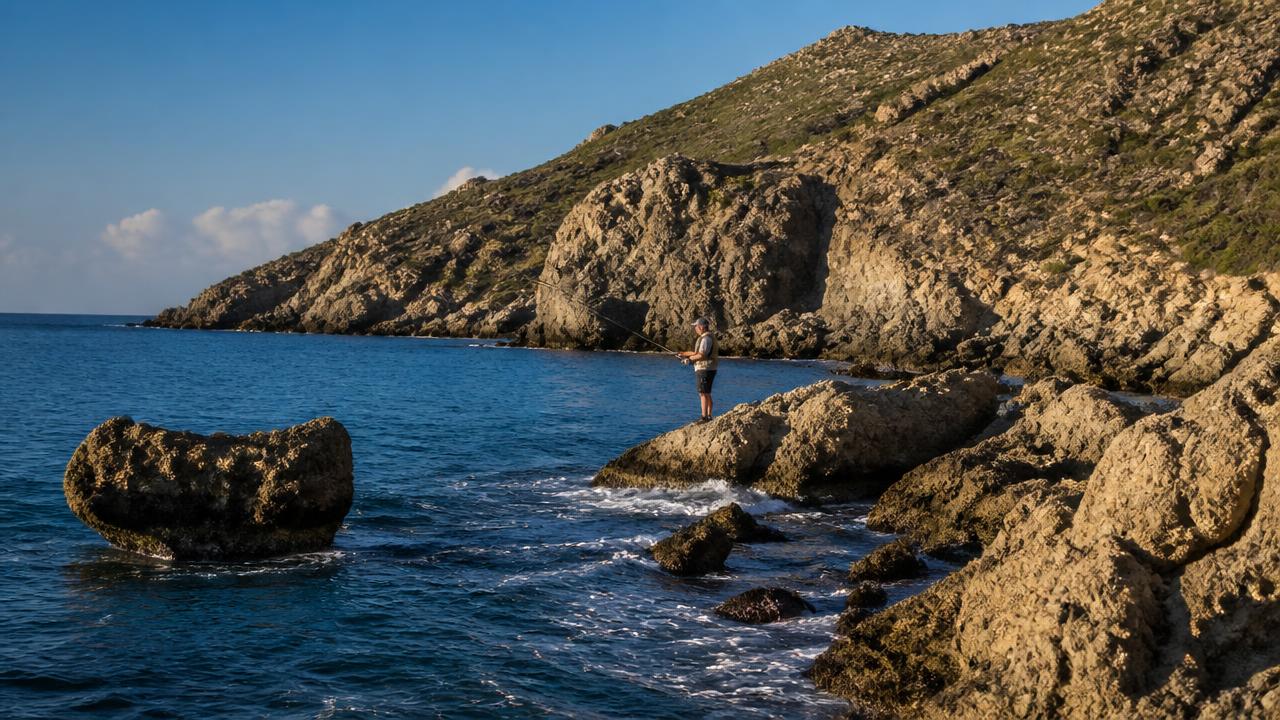
HRF fishing rewards reading ground more than chasing named marks. The same type of structure repeats itself around Cyprus, and once you can recognise it from the coast road, you will find productive water in far more places than any single list of spots could cover. This guide focuses on the ground types that consistently hold grouper, wrasse, dentex and amberjack, and the general areas of the island where you will find plenty of it.
Reading HRF ground
Good HRF ground shares a few features wherever it is found on the island. Depth needs to be close in, often within a few metres of dry rock, because HRF is a close-range style rather than a long-casting one. The rock itself should be broken and uneven — boulders, cracks, small caves and ledges — rather than a flat, featureless platform, because predatory fish need places to ambush from and hide in.
Current also matters. Headlands and points that push a bit of movement past the rock tend to concentrate baitfish, and baitfish is what draws in the bigger species HRF anglers are after. A completely still, enclosed bay rarely fishes as well as an exposed point with some water movement.
Steep drop-off headlands
Headlands where the rock plunges quickly into deep water are the classic HRF venue. These marks let you cast a lure that lands in 10–20 m of water within a rod length or two of the shoreline, which is exactly the depth range where grouper and dentex often sit.
Cyprus's east coast, particularly the stretch around Cape Greco, Protaras and towards Ayia Napa, has a good concentration of this kind of headland. Similar structure appears in patches along the Limassol coastline and around parts of Paphos and the Akamas peninsula, though it is less continuous there.
Boulder fields and broken reef
Away from the dramatic drop-offs, stretches of broken boulder and reef ground — sometimes just below the surface, sometimes in a few metres of water — are superb for slow-worked soft plastics. This is where big wrasse in particular tend to sit, using the gaps between boulders as ambush points.
This kind of ground is more widespread than the steep headlands and turns up in patches all around the coast. It rewards patience: working a soft plastic slowly through the gaps rather than covering water quickly is usually what separates a productive session here from a quiet one.
Deep gullies and cave systems
Narrow gullies cutting into the rock, and small cave mouths at the base of cliffs, are prime grouper territory. These features hold fish tight against cover, and a lure worked right along the edge of a gully — rather than over open water nearby — will often draw a strike that a cast a metre or two further out would not.
This kind of ground is common on the more rugged sections of the Famagusta coastline and around the Cyclops Cave area, where the rock is broken enough to create plenty of this micro-structure without needing exact spot knowledge to find it.
Matching leader to ground
The rougher and more cave-riddled the ground, the heavier your leader needs to be, because the fight will happen entirely at close range with the fish trying to reach cover immediately. Over cleaner boulder fields you can afford to drop leader strength slightly for better presentation; over cave systems and tight gullies, go as heavy as you can while still getting bites.
A word on access and safety
Some of the best HRF ground is also some of the least forgiving to walk on. Wet limestone is slippery, swell can arrive without much warning on exposed headlands, and gullies and caves are exactly the features that funnel wave energy unpredictably. Scout any new area on a calm day before fishing it in anything more challenging, and always fish with an escape route in mind.
Frequently asked questions
- Do I need to know exact spots to HRF fish well in Cyprus?
- Not really. HRF rewards learning to read ground — steep drop-offs, broken boulder fields, gullies and cave systems — more than chasing named marks. Once you can spot this structure from the coast road, productive ground is common around the island.
- Which part of Cyprus has the best HRF ground?
- The east coast around Cape Greco, Protaras, Ayia Napa and the Cyclops Cave area has an unusually good concentration of steep, deep-close-in rock, but similar ground exists in patches around Limassol, Paphos and the Akamas coastline.
- What ground type is best for grouper?
- Deep gullies, cave mouths and broken boulder fields close to deep water tend to hold grouper, since they rely on structure to ambush prey and retreat into. Working a lure tight along the edges of these features is more productive than fishing open water nearby.
- Is it safe to explore new HRF ground alone?
- It's best avoided. Scout unfamiliar rocky ground on a calm day, ideally with someone else present, before deciding whether to fish it in more challenging conditions.
Recommended gear for this guide
Live picks from the Hobby Mania Cyprus catalogue that suit the setups described above.
Share this guide