Draft — pending fishing-accuracy review. Not listed on the site and not indexed by search engines.
Techniques
Heavy Rock Fishing (HRF) in Cyprus: the complete guide
Fishing.com.cy Editorial · 7 min read · Published · Updated
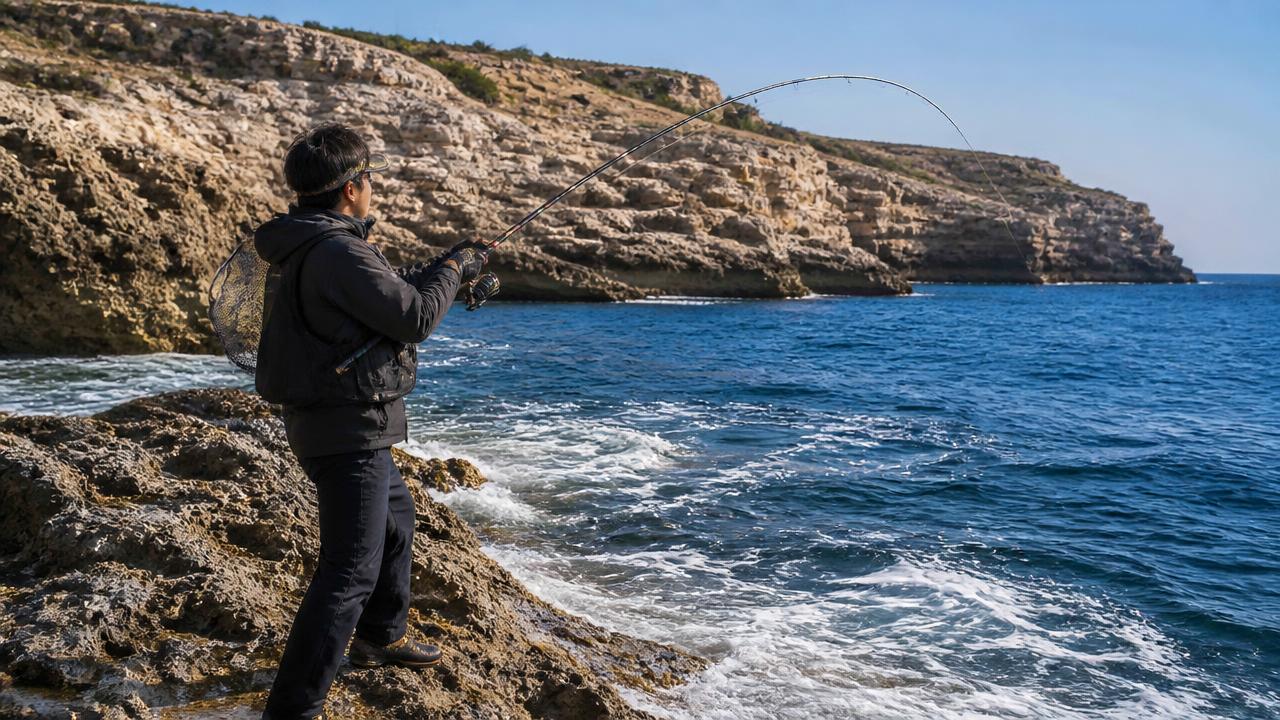
HRF fishing — heavy rock fishing — is what LRF grows into once you start targeting the bigger, harder-fighting predators that live over Cyprus's roughest ground. Instead of picking apart a marina wall for gobies and small wrasse, HRF is about probing broken limestone reef, deep gullies and steep headlands for grouper, big wrasse, dentex and amberjack, using tackle strong enough to turn a fish's head before it reaches the structure. This guide covers the ground, the tackle, the lures and retrieves, and — because this style of fishing puts you on some genuinely serious terrain — the safety habits that keep an HRF session enjoyable rather than dangerous.
What HRF actually is
HRF sits between light rock fishing and full shore jigging. Where LRF uses sub-10 g jigheads and 2–3 lb line to pick off small species, and shore jigging is about long casts with heavy metals for pelagics in open water, HRF is a close-range, structure-focused style. You are usually fishing lures of 15–40 g on stouter rods, working them tight to rock faces, ledges, caves and boulder fields where bigger predatory fish sit in ambush.
The appeal is the fight. Grouper, large wrasse and dentex hooked over rock do not swim away from structure — they use it, diving straight back into cracks and ledges the instant they feel the hook. HRF tackle exists specifically to win that first few seconds, because if a big fish gets its head into a crevice, the fight is usually over regardless of how strong your line is.
The ground HRF suits
Cyprus has no shortage of the broken limestone and volcanic rock this style needs. Look for steep drop-offs where the rock plunges quickly into deep water, boulder fields with gaps and caves, and headlands where currents push bait against the structure. The east coast around Famagusta, Protaras, Ayia Napa and the Cyclops Cave area is some of the most productive HRF ground on the island, but similar structure exists on stretches of the Limassol and Paphos coastline too.
What you are looking for visually is broken, uneven rock rather than flat ledges, some depth close in (often reachable within a rod length or two of dry ground), and signs of life — baitfish flicking on the surface, birds working an area, or simply a stretch of coast that looks wild and untouched rather than manicured.
Rods and reels for HRF
An HRF rod needs backbone without being a full shore jigging stick. Most anglers settle on something in the 2.4–3.0 m range with a casting weight around 15–50 g and a fast, powerful action through the butt — enough to bully a fish away from structure on the strike, while still having enough tip sensitivity to work lighter lures and feel takes over rock.
Reels need to be robust rather than fast. A 4000–6000 size spinning reel with a strong, smooth drag and decent sealing against salt spray is the standard choice, because you will be winching fish hard on a locked-down drag rather than letting them run.
- Rod: 2.4–3.0 m, 15–50 g casting weight, fast action with real backbone
- Reel: 4000–6000 size, strong drag, sealed bearings where possible
- Set drag firm — HRF is about stopping fish, not playing them out
Braid and leader
PE braid in the PE1.5–PE3 range covers most HRF work, giving good casting distance for the lure weights involved with enough raw strength to horse a fish away from cover. Because the fight happens right next to sharp rock, leader is where you cannot afford to be light.
Fluorocarbon leaders of 40–60 lb, sometimes heavier for known grouper or amberjack ground, are standard. Fluorocarbon's abrasion resistance and low visibility both matter here — Cyprus water is clear, and fish get a good look at everything before they commit.
- Mainline: PE1.5–PE3 braid
- Leader: 40–60 lb fluorocarbon, heavier over known big-fish ground
- Retie leader regularly — a session of abrasion against rock weakens it even when it looks fine
Lures and retrieves
HRF lure choice depends heavily on the ground and what is holding on it that day. Soft plastics on heavier jigheads — paddle tails and creature baits in the 10–20 cm range — are excellent for working slowly along the bottom and into gullies where grouper and big wrasse hold. A slow lift-and-drop retrieve, letting the lure settle into cracks between movements, draws strikes from fish that would ignore something moving too fast.
Hard lures — sinking stickbaits, jerkbaits and deep divers — suit fishing tighter to the rock face itself, particularly for dentex and amberjack that will chase a fleeing baitfish pattern. A twitch-pause retrieve that imitates a wounded fish is usually more effective than a steady wind.
Metal jigs earn their place too, especially where the ground drops away quickly and amberjack or bonito are working the water column rather than sitting tight to structure — cast and retrieve with sharp jerks, or let the jig flutter down on the drop where takes often come.
- Soft plastics: slow lift-and-drop over broken ground, let it settle into gaps
- Hard lures: twitch-pause along rock faces for dentex and amberjack
- Metal jigs: cast-and-retrieve or flutter on the drop over deeper structure
Terminal tackle and rigging
Strong, sharp hooks matter more in HRF than almost anywhere else — a fish that gets even a second's slack over rock will use it. Jigheads should be rated well above the lure's apparent weight class to cope with the hookset needed to turn a big fish's head, and split rings and swivels should be rated similarly heavy, since a weak link fails exactly when you need it most.
Carry spares. Snagging on this ground is routine, not occasional, and losing a lure to a crack in the rock is simply part of the cost of fishing it properly.
Target species
Grouper are the classic HRF target — ambush predators that sit tight in caves and cracks and hit hard, then bury straight back into cover. Landing one over rock is as much about the first three seconds after the take as anything else.
Large wrasse, present in good numbers over Cyprus's rocky ground, give a similarly dogged, structure-hugging fight and will take both soft plastics and hard lures confidently. Dentex are a genuine prize — fast, powerful, and usually encountered around dawn and dusk hunting baitfish along rock faces. Amberjack turn up on HRF ground too, particularly where deep water sits close to structure, though like all larger pelagics from the shore they should be considered a seasonal, condition-dependent bonus rather than a guaranteed target.
Season and timing
HRF fishing works for most of the year on Cyprus's rocky coast, but the strongest activity tends to fall in the warmer months when predatory fish push closer to structure to feed on baitfish. Dawn and dusk are consistently the most productive windows, both for the light and because many of the target species feed most actively at the edges of the day.
Sea conditions matter as much as the calendar. A calm sea with a gentle swell is far more fishable and far safer than a flat, glassy day that can turn quickly, or a day with a heavy groundswell that makes wet rock lethal underfoot.
Safety on HRF ground
This is the part of HRF fishing that deserves as much attention as the tackle. The ground that makes HRF productive — steep, broken, deep close in — is exactly the ground that causes accidents. Limestone becomes extremely slippery when wet, and a rogue set of waves can sweep an angler off a ledge that looked perfectly safe minutes earlier.
Never fish HRF marks alone if you can help it, and if you must, tell someone exactly where you are and when you expect to be back. Wear proper grippy footwear, not trainers. Watch the sea for several minutes before committing to a spot, note where the larger sets are breaking, and always know your escape route off the rock before you start fishing rather than working it out in a hurry. Keep a phone in a dry pouch, and never turn your back on the water for long.
- Check conditions and swell forecast before you go, and change plans if it looks marginal
- Never fish alone on serious HRF ground if it can be avoided; always tell someone your plan
- Wear grippy, purpose-made rock fishing footwear
- Watch the sea for several minutes before setting up, and identify your escape route
- Keep gear and yourself well back from the edge when not actively fishing
Frequently asked questions
- What is the difference between HRF and LRF fishing?
- LRF (light rock fishing) uses ultralight tackle and tiny lures for small species like gobies and small wrasse, usually from safe, flat ground. HRF (heavy rock fishing) uses much stronger tackle to target larger predators such as grouper and dentex over rougher, often more dangerous rocky ground.
- What tackle do I need to start HRF fishing in Cyprus?
- A rod around 2.4–3.0 m rated 15–50 g, a 4000–6000 reel with a strong drag, PE1.5–PE3 braid and 40–60 lb fluorocarbon leader is a solid starting point. Add a mix of soft plastics, hard lures and metal jigs to cover different ground and moods.
- Where can I HRF fish in Cyprus?
- Broken limestone and volcanic rock with deep water close in is what to look for, and the east coast around Famagusta, Protaras, Ayia Napa and the Cyclops Cave area is particularly well suited. Similar ground exists on parts of the Limassol and Paphos coastline too.
- Is HRF fishing dangerous?
- It can be, because the ground that produces fish is often steep, wet and exposed to swell. Treat every session with real caution: check conditions first, avoid fishing alone, wear proper footwear and always know your escape route before you start.
- What fish can you catch HRF fishing in Cyprus?
- Grouper and large wrasse are the classic HRF targets, both ambush predators that fight hard close to structure. Dentex and amberjack also turn up on HRF ground, though larger pelagics like amberjack should be treated as seasonal, condition-dependent bonuses rather than reliable catches.
Recommended gear for this guide
Live picks from the Hobby Mania Cyprus catalogue that suit the setups described above.
Share this guide