Draft — pending fishing-accuracy review. Not listed on the site and not indexed by search engines.
Gear & Tackle
Best Rod and Reel Setup for Cyprus Dam Fishing
Fishing.com.cy Editorial · 5 min read · Published · Updated
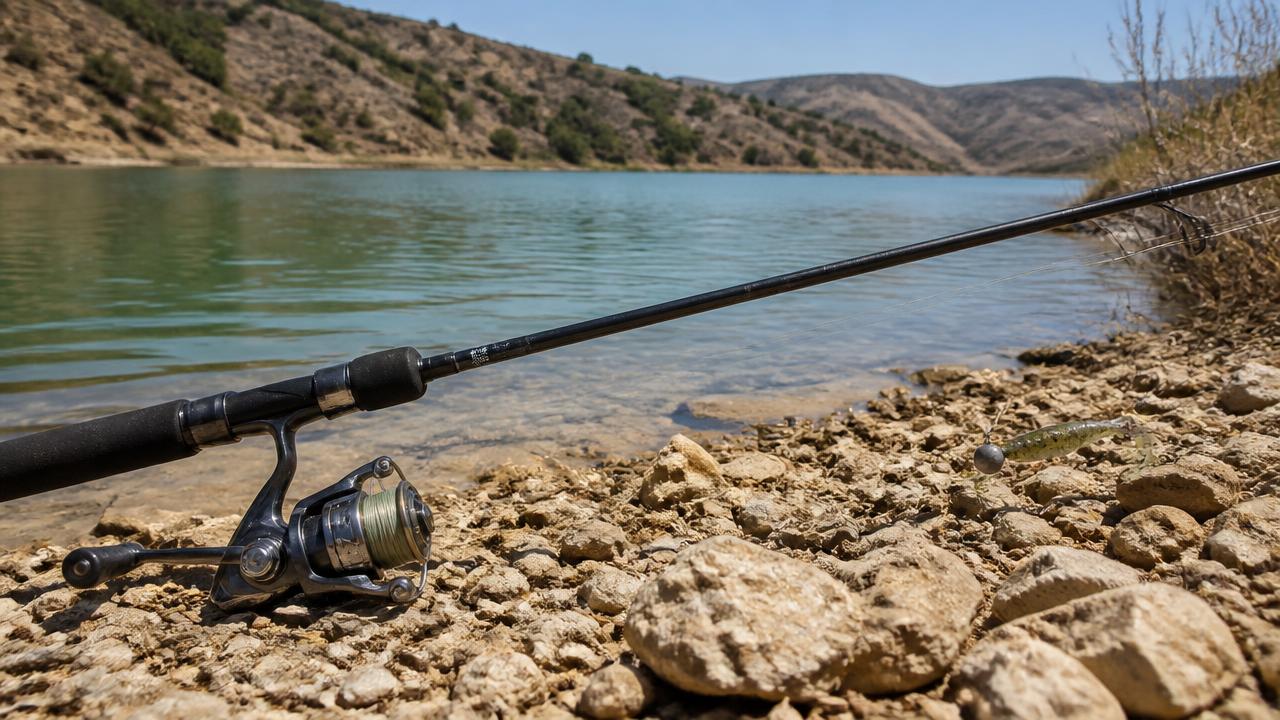
Choosing a rod, reel and line for Cyprus dam fishing is mostly about matching your setup to the lures you actually plan to throw, since a rod built for light finesse plastics and one built for crankbaits and heavier jigs behave very differently. This guide covers spinning rod lengths and power ratings, fast versus moderate action, reel sizing, and the trade-offs between braid, fluorocarbon and mono, finishing with a workable compromise for anglers who only want to own one outfit.
Spinning rod length: what changes with each range
Most Cyprus dam bank fishing is comfortably covered by rods between about 1.98m and 2.4m. Shorter rods in this range give better accuracy for pitching soft plastics tight to cover such as flooded brush and rock, which matters when banks are lined with snags. Longer rods add casting distance, useful on open banks and points where you need to reach fish holding well off the shore, and they also give a little more control when playing a fish around bankside obstructions.
Casting weight and power ratings
A light power rod rated roughly 3–15g suits finesse work: ned rigs, drop shots, small jigheads and light hard lures. A medium power rod rated roughly 7–28g handles the bulk of general dam fishing, comfortably casting Texas rigs, mid-size crankbaits and spinnerbaits. A medium-heavy rod rated up to around 40g earns its place if you regularly punch heavier weights into thick cover or fish larger swimbaits.
Choosing too light a rod for the lures you actually fish makes casting heavier weights unpleasant and reduces hook-setting power in cover; choosing too heavy a rod for finesse work kills the feel needed to detect subtle bites.
Fast versus moderate action
Action describes how far up the blank a rod bends. A fast action rod, bending mainly in the top third, gives crisp, immediate hook sets and the sensitivity to feel light taps on soft plastics and jigs, making it the better general choice for most dam techniques.
A moderate action rod, bending further down the blank, absorbs more shock on the strike and during a fight, which suits treble-hooked hard lures such as crankbaits and minnows, where a softer response helps prevent hooks pulling free during a jump or headshake. Anglers who fish both plastics and hard lures regularly often end up owning one of each rather than trying to find a single action that does both well.
Reel size: 2000 versus 3000
A 2000-size spinning reel suits lighter rods and finesse lures, staying light in the hand through a long session and balancing well with shorter, lighter rods. A 3000-size reel offers a larger spool for slightly heavier line and lures, more retrieve power for pulling fish clear of cover, and a bit more drag capacity, making it the better match for medium and medium-heavy rods used with crankbaits, spinnerbaits and Texas-rigged plastics in snaggy water.
Neither is wrong; the decision should follow the rod and lure range you have already chosen rather than the other way round.
Braid, fluorocarbon or mono as mainline
Each mainline choice trades off differently for dam fishing, and picking one is really about which weaknesses you can live with.
Braid
Thin diameter for its strength, virtually no stretch, and excellent bite detection and hook-setting power, which matters when fishing soft plastics around cover where a solid, immediate hook set is needed to pull a fish clear of snags. It is more visible in clear water and less abrasion resistant than fluorocarbon, so it is usually paired with a fluorocarbon leader.
Fluorocarbon as mainline
Low visibility and good abrasion resistance make straight fluorocarbon a sound choice for clear-water finesse fishing where a wary fish might be put off by a visible line, though its stiffness compared with mono can slightly reduce casting distance with very light lures.
Monofilament
Cheap, forgiving, with useful stretch that helps absorb a hard strike on treble-hooked hard lures, reducing pulled hooks. It is bulkier and less sensitive than braid, so it suits crankbait and minnow fishing better than finesse plastics where bite detection matters most.
Leader choice
When running braid as the mainline, a fluorocarbon leader of roughly one to two metres in the 8–16lb range covers most Cyprus dam situations, with the lighter end for finesse presentations in clear water and the heavier end for fishing tighter to cover or targeting larger fish. The leader's low visibility and abrasion resistance near the lure matter more than on the mainline itself, since this is the section that contacts rock, timber and a fish's mouth directly.
A sensible one-rod compromise
Most anglers do not want to carry three outfits to a dam. If you can only justify one setup, a medium power, fast action spinning rod around 2.1–2.2m, paired with a 2500-size reel loaded with 8–10lb braid and a metre of 10–12lb fluorocarbon leader, will cast the widest practical range of lures reasonably well: soft plastics on various rigs, light-to-medium crankbaits, spinnerbaits and small hard lures.
It will not be the perfect tool for the lightest finesse work or for punching heavy weights into the thickest cover, but it avoids being badly wrong for anything you are likely to throw on a typical Cyprus dam session, which is the realistic goal of a single do-everything setup.
Frequently asked questions
- What size reel is best for Cyprus dam bass fishing?
- A 2000-size reel suits lighter rods and finesse presentations, while a 3000-size reel offers more retrieve power and drag capacity for medium and medium-heavy rods fishing crankbaits, spinnerbaits and heavier plastics. Match the reel to your rod and typical lure weight rather than choosing in isolation.
- Should I use braid or fluorocarbon for Cyprus dam fishing?
- Braid with a fluorocarbon leader suits most soft plastic and jig fishing thanks to its sensitivity and hook-setting power, while straight fluorocarbon or mono can suit clear-water finesse work or treble-hooked hard lures where mono's stretch helps cushion the strike. There is no single correct answer; it depends on the lure and technique.
- What is the best all-round rod for Cyprus dam fishing?
- A medium power, fast action spinning rod around 2.1 to 2.2 metres is the most sensible single compromise, casting a wide range of soft plastics and light-to-medium hard lures reasonably well without being badly suited to any of them.
- Do I need a heavier rod for crankbaits than for soft plastics?
- Not necessarily heavier, but often a slightly more moderate action, since crankbaits and other treble-hooked hard lures benefit from a softer bend that absorbs headshakes and reduces pulled hooks, whereas soft plastics generally reward a fast action for solid hook sets.
Recommended gear for this guide
Live picks from the Hobby Mania Cyprus catalogue that suit the setups described above.
Share this guide