Draft — pending fishing-accuracy review. Not listed on the site and not indexed by search engines.
Fishing Spots
Shore Jigging at Cyclops Cave
Fishing.com.cy Editorial · 6 min read · Published · Updated
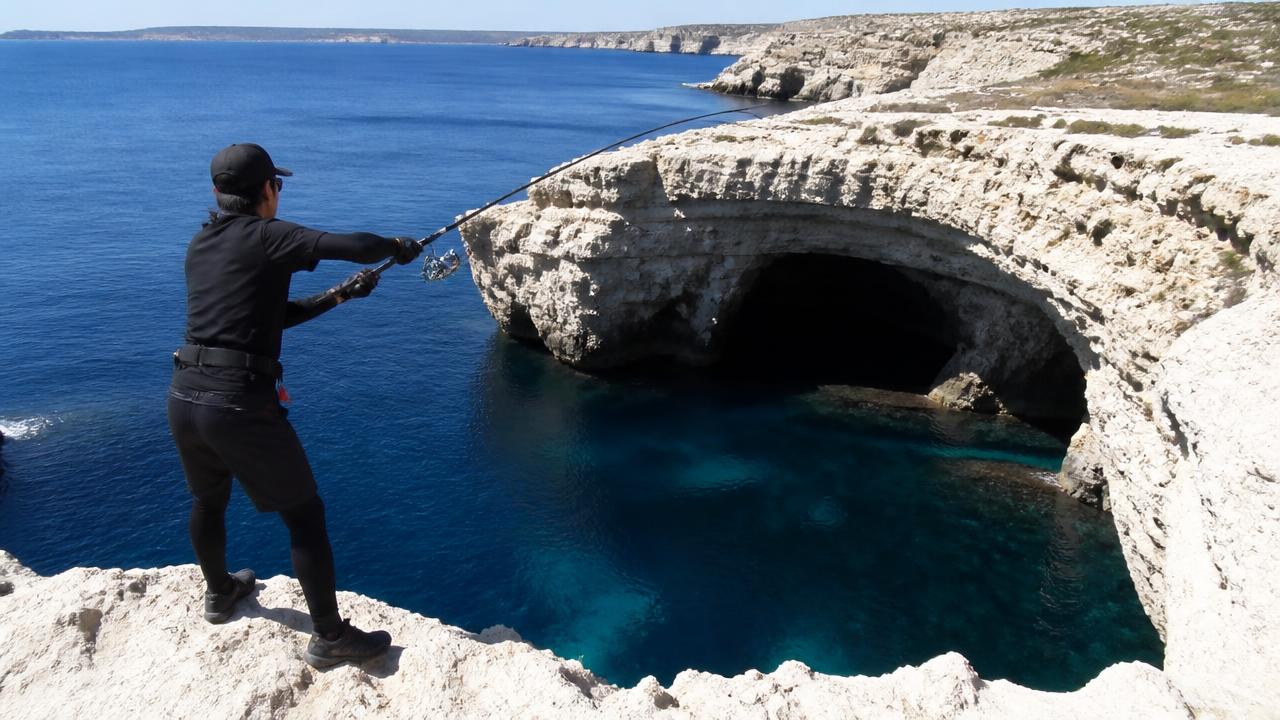
Cyclops Cave is one of the best-known deep-water rock formations on the Cyprus coastline, and it draws shore jigging anglers because genuine depth sits so close to the rocks. It is also one of the more demanding marks on the island in terms of access and sea conditions. This guide covers what to expect in terms of ground and tackle, what species are realistically on offer, and — because this mark genuinely warrants it — a detailed safety section. We are deliberately not giving exact coordinates or describing precise access routes; treat this as background to research and assess in person, in good conditions, before ever fishing here.
Why Cyclops Cave attracts shore jigging anglers
The appeal is simple: unusually deep water sits within realistic casting range of the rock, without needing a boat. That combination — depth, current and dramatic rock structure — is exactly what shore jigging exploits, and it is why this stretch of coast has a reputation among Cyprus anglers.
That same depth close to shore is also precisely what makes the mark more hazardous than an ordinary beach or gently shelving rock ledge, and the two facts cannot be separated. Anyone drawn here for the fishing needs to take the access and safety side at least as seriously as the tackle.
Ground and access
The ground around Cyclops Cave is rocky and uneven, with limestone that is frequently damp, sometimes covered in algae, and can be sharp underfoot. Access typically involves scrambling over rock rather than walking a level path, and the terrain can change with sea state — ground that is dry and easy on a calm day may be wet, slick, or partially awash after any recent swell.
Because access is uneven and sometimes exposed, this is not a mark to attempt for the first time in poor light, in a hurry, or in unfamiliar footwear. If you have not visited before, do so first in calm daylight conditions purely to assess the terrain, without necessarily fishing, before committing to a jigging session.
Tackle and jig choice
The depth on offer rewards a rod capable of casting jigs in the heavier part of the usual shore jigging range — commonly from around 60g up to 100g or more depending on conditions — paired with a large, robust saltwater spinning reel carrying a strong, smooth drag and plenty of braid capacity, since fish here can use both depth and rock to test tackle hard.
PE3 to PE4 braid is a sensible range for this kind of ground, balancing casting distance against the abrasion and lifting power needed if a fish tries to bury itself around rock. A fluorocarbon leader of significant breaking strain, chosen for abrasion resistance rather than delicacy, is the standard choice given the rough bottom.
Jig weight and profile should be matched to the depth you are fishing and the current on the day — a jig that sinks too slowly in a strong current will end up well away from where you intended it to fish. Vary retrieve speed and jig weight through a session rather than assuming one setup will cover the whole tide.
Realistic species expectations
Amberjack are the most realistic notable target from this kind of deep, rocky ground, though as with anywhere in Cyprus they are not guaranteed and can require persistence across multiple sessions. Leerfish and smaller pelagic species may also turn up. Larger pelagics such as tuna are possible in principle given the depth on offer, but they remain rare, highly seasonal and entirely condition-dependent — do not plan a session around the expectation of encountering one; see our dedicated tuna article for a fuller, honest picture of that possibility.
It is worth going into any session at a mark like this expecting hard work and the strong chance of a quiet day, with the occasional better fish as the reward for persistence rather than the norm.
Safety: read this before you go
Cyclops Cave combines several risk factors that individually would each demand caution, and together demand a genuinely conservative approach: deep water immediately adjacent to the rock, uneven and often slippery limestone access, and exposure to swell from open water with limited shelter.
Swell here can arrive in sets, meaning several smaller waves followed by a noticeably larger one — the classic pattern that catches out anglers who judge safety from a single calm-looking spell rather than watching for several minutes. A wave that would be unremarkable on a sheltered beach can sweep across low rock shelving straight into deep water, and the depth immediately offshore means there is little to arrest a fall beyond the water itself.
- Check the swell forecast and do not go if conditions are worse than you are comfortable with
- Watch the sea for several minutes before approaching any low rock
- Wear proper grippy footwear for wet limestone
- Identify an escape route before you start fishing, and keep it clear
- Never fish here alone — go with a companion or tell someone your exact plan and return time
- Turn back if conditions deteriorate rather than trying to finish a session
Swell and sea state
Check the wind and swell forecast before travelling, and be prepared to turn back or fish from further inland ground if conditions are worse than expected on arrival. Watch the sea for at least several minutes from a safe distance before approaching any lower rock, since wave sets are unpredictable and a run of small waves does not mean the next one will be the same size.
Slippery rock and footing
Limestone here is frequently damp from spray even in otherwise dry conditions, and algae growth on lower rock can be effectively invisible until you are already on it. Wear footwear with genuine grip designed for wet rock, move deliberately rather than hurrying between casts, and keep both hands free where possible when moving across uneven ground.
Access and escape routes
Before you start fishing, identify how you would leave the area quickly if the sea picked up or you needed to get clear in a hurry, and make sure that route does not itself rely on crossing ground that could be cut off by rising water. Do not fish so far out on exposed rock that your escape route could be blocked by a change in conditions during your session.
Never fish alone
This is not a mark to fish solo. Bring a companion, or at an absolute minimum tell someone reliable exactly where you are going and when you expect to return, and check in with them afterwards. A slip on wet rock or a sudden wave can turn from inconvenient to serious very quickly if there is no one aware you are there.
A final word
Cyclops Cave rewards anglers who treat it with respect: good tackle matched to the ground, patience with realistic expectations of the fishing, and genuine caution around the sea and rock. None of that removes the risk entirely, and no article can substitute for assessing conditions in person on the day. If in doubt, do not go down onto the rock — there will be other days.
Frequently asked questions
- Is Cyclops Cave safe for shore jigging?
- It can be fished safely by experienced anglers who check conditions carefully, wear appropriate footwear, never fish alone and are prepared to turn back if the sea picks up. It is not a beginner-friendly mark and should not be treated casually.
- What tackle do I need for shore jigging at Cyclops Cave?
- A rod capable of casting heavier jigs, roughly 60–100g depending on conditions, paired with a large saltwater spinning reel with a strong drag, PE3–PE4 braid and a robust fluorocarbon leader suited to abrasive, rocky ground.
- What fish can you realistically catch at Cyclops Cave?
- Amberjack and leerfish are the most realistic targets on the right day. Larger pelagics such as tuna are possible given the depth but remain rare and highly condition-dependent, so they should not be the basis of your expectations.
- Can I fish Cyclops Cave alone?
- It is strongly recommended that you do not. The combination of deep water, slippery rock and exposure to swell makes this a mark where fishing alone significantly increases risk. Bring a companion or at minimum tell someone your exact plan.
- What time of year is best for shore jigging at Cyclops Cave?
- Late spring through autumn generally offers the most consistent activity, in line with shore jigging elsewhere in Cyprus, though sea conditions on the day should always take priority over the calendar when deciding whether to fish.
Recommended gear for this guide
Live picks from the Hobby Mania Cyprus catalogue that suit the setups described above.
Share this guide